Interesting. The next few posts are from you YouTube videos of timber frame structures being built.
This is a group students building a timber frame house.
Saturday, March 03, 2007
Students Build a Timber Frame House

Wednesday, February 14, 2007
Wood Protection Association
I ran across the Wood Protection Council Today. The text below is from their homepage. It seems like a good organization for information and training for the UK and, maybe, EU standards.
Welcome to the Wood Protection Association – Preserving Confidence in Timber!
Wood is a superb material and the only truly sustainable resource for construction. Plantation grown softwoods from certified sources are most widely used in construction but such timber lacks sufficient natural durability for many situations. However, the correct treatment in conjunction with good design and maintenance will deliver exceptional performance for any application.
The Wood Protection Association provides:
■ Advice on selection of suitable wood species for different end-uses
■ Advice on selection of appropriate wood protection products
■ Specifications for high quality preservative treatments for all Use Classes
■ Specifications for flame retardant treatments
■ Information on suppliers of coatings, preservatives, flame retardants and wood treated with these products
■ Information on safe and effective use of all types of wood protection products and treated timber
For safety, value and versatility, pre-treated timber is the ideal construction material. Yet, along with its practical benefits, its use also has considerable environmental importance making possible the continued utilisation of timber with the lasting care of the world's forest resources.
http://www.wood-protection.org/default.asp
Tuesday, February 13, 2007
Forest Products Laboratory Wood Handbook
This leads to the Forest Products Laboratory Wood Handbook page where you can download the book in one pdf (very large file) or by chapter. Here is the table of contents, which is on that page (the links for each chapter are active):
Cool book and it's free.
Front matter (PDF 292 KB)
Preface
Acknowledgments
Contributors
Chapter 1 -- Characteristics and Availability of Commercially Important Wood (PDF 916 KB)
Timber Resources and Uses
Species Descriptions
U.S. Wood Species
Imported Woods
Chapter 2 -- Structure of Wood (PDF 434 KB)
Bark, Wood, Branches, and Cambium
Sapwood and Heartwood
Growth Rings
Wood Cells
Chemical Composition
Species Identification
Chapter 3 -- Physical Properties and Moisture Relations of Wood (PDF 495 KB)
Appearance
Moisture Content
Shrinkage
Weight, Density, and Specific Gravity
Working Qualities
Decay Resistance
Thermal Properties
Electrical Properties
Coefficient of Friction
Nuclear Radiation
Chapter 4 -- Mechanical Properties of Wood (PDF 1.2 MB)
Orthotropic Nature of Wood
Elastic Properties
Strength Properties
Vibration Properties
Mechanical Properties of Clear Straight-Grained Wood
Natural Characteristics Affecting Mechanical Properties
Effects of Manufacturing and Service Environments
Chapter 5 Commercial Lumber (PDF 551 KB)
Hardwood Lumber
Softwood Lumber
Purchase of Lumber
Commonly Used Lumber Abbreviations
Chapter 6 -- Lumber Stress Grades and Design Properties (PDF 329 KB)
Responsibilities and Standards for Stress Grading
Visually Graded Structural Lumber
Machine-Graded Structural Lumber
Adjustment of Properties for Design Use
Chapter 7 -- Fastenings (PDF 1.1 MB)
Nails
Spikes
Staples
Drift Bolts
Wood Screws
Lag Screws
Bolts
Connector Joints
Multiple-Fastener Joints
Metal Plate Connectors
Fastener Head Embedment
Chapter 8 -- Structural Analysis Equations (PDF 320 KB)
Deformation Equations
Stress Equations
Stability Equations
Chapter 9 -- Adhesive Bonding of Wood Materials (PDF 433 KB)
Adhesion to Wood
Surface Properties of Wood Adherends
Physical Properties of Wood Adherends
Adhesives
Bonding Process
Bonded Joints
Testing and Performance
Chapter 10 -- Wood-Based Composites and Panel Products (PDF 904 KB)
Scope
Types of Conventional Composite Materials
Adhesive Considerations
Additives
General Manufacturing Issues
Standards for Wood-Based Panels
Plywood
Particle and Fiber Composites
Wood-Nonwood Composites
Chapter 11 -- Glued Structural Members (PDF 975 KB)
Structural Composite Lumber
Glulam
Glued Members With Lumber and Panels
Structural Sandwich Construction
Chapter 12 -- Drying and Control of Moisture Content and Dimensional Changes (PDF 1.3 MB)
Determination of Moisture Content
Recommended Moisture Content
Drying of Wood
Moisture Control During Transit and Storage
Dimensional Changes in Wood
Design Factors Affecting Dimensional Change
Wood Care and Installation During Construction
Chapter 13 -- Biodeterioration of Wood (PDF 599 KB)
Fungus Damage and Control
Bacteria
Insect Damage and Control
Marine Borer Damage and Control
Chapter 14 -- Wood Preservation (PDF 1.2 MB)
Wood Preservatives
Preservative Effectiveness
Effect of Species on Penetration
Preparation of Timber for Treatment
Application of Preservatives
Handling and Seasoning of Timber After Treatment
Quality Assurance for Treated Wood
Chapter 15 -- Finishing of Wood (PDF 2.2 MB)
Factors Affecting Finish Performance
Control of Water or Moisture in Wood
Types of Exterior Wood Finishes
Application of Wood Finishes
Finish Failure or Discoloration
Finishing of Interior Wood
Finishes for Items Used for Food
Wood Cleaners and Brighteners
Paint Strippers
Lead-Based Paint 15-35
Chapter 16 -- Use of Wood In Building and Bridges (PDF 779 KB)
Light-Frame Buildings
Post-Frame and Pole Buildings
Log Buildings
Heavy Timber Buildings
Timber Bridges
Considerations for Wood Buildings
Chapter 17 -- Fire Safety (PDF 318 KB)
Fire Safety Design and Evaluation
Fire Performance Characteristics of Wood
Flame-Retardant Treatments
Chapter 18 -- Round Timbers and Ties (PDF 396 KB)
Standards and Specifications
Material Requirements
Availability
Form
Weight and Volume
Durability
Strength Properties
Chapter 19 -- Specialty Treatments (PDF 298 KB)
Plasticizing Wood
Modified Woods
Paper-Based Plastic Laminates
Glossary (PDF 178 KB)
Index (PDF 154 KB)
Vermont Timber Works - Mortise and Tenon
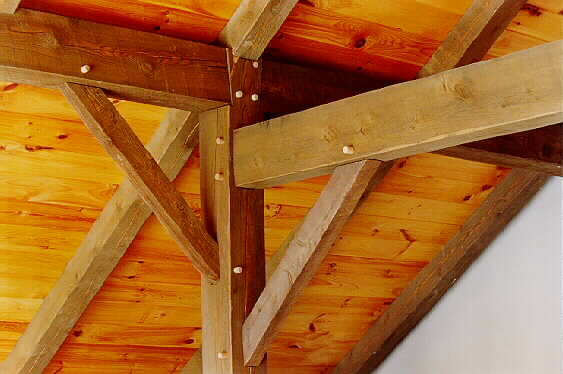 I found Vermont Timber Works online today. They have done some impressive work and have a very nice explanation of their methods at http://www.vermonttimberworks.com/joints.html
This picture is a great example of mortise and tenon work.
Here is their "tools of the trade" page showing that they do a lot of their work by hand. Funny that I do not see a CNC machine.
Monday, February 12, 2007
Welco Lumber

This is an interesting supplier who was off my radar until recently - Welco Lumber
A list of their product lines...
Wood Preservatives: we offer wood preservative treatments of CCA, ACQ, Creosote, ACZA, and Penta.
Re-manufacturing: we offer a complete service of custom dressing, ripping, chopping, trim sawing, custom dapping, and custom drilling.
Custom Cut: we can offer all sizes up to 50 ft. of custom cut timbers in all species. Our timbers are used in many projects such as hotels, temples, aquariums, libraries, damns, canals, tunnels and wharves.
Bridges: we supply timbers to contractors servicing the forestry, oil & gas industry as well as pipeline contractors and government agencies.
Railway: we supply rail companies, treaters and contractors with crossing planks, cross ties and railway bridge timbers.
Marine: we supply timbers and piling for use in coastal marine applications both treated and not treated.
Log Home: we supply throughout North America; waney cants, slabbed logs, house logs, and appearance grade timbers, as well as D. logs in 6 x 8 and 8 x 8. All of our log home timbers are produced to meet or exceed Wall Log 40 Grade and are available in lengths up to 50 feet.
Our mills in Northern British Columbia log heavily in the winter months. The extreme cold climate slows growth, improves wood quality, and yields wood with a low and uniform moisture content. We use dense, high quality pine and spruce which is resistant to checking and we also air dry our cants to a moisture content of maximum 23%.
Oil & Gas: we supply pipeline skids, bridge timbers and pipeline chauls as well as crane mats in both hardwoods and softwoods for crane matts, please see our link to www.tundramatt.com
Sawmills: our exclusive mills are located in northern British Columbia and Southern Alberta producing in excess of 50 million board feet annually.
This page is at http://www.welcolumber.com/products-timbers.html
I like their favicon although I would prefer more pictures on their site.
A list of their product lines...
Wood Preservatives: we offer wood preservative treatments of CCA, ACQ, Creosote, ACZA, and Penta.
Re-manufacturing: we offer a complete service of custom dressing, ripping, chopping, trim sawing, custom dapping, and custom drilling.
Custom Cut: we can offer all sizes up to 50 ft. of custom cut timbers in all species. Our timbers are used in many projects such as hotels, temples, aquariums, libraries, damns, canals, tunnels and wharves.
Bridges: we supply timbers to contractors servicing the forestry, oil & gas industry as well as pipeline contractors and government agencies.
Railway: we supply rail companies, treaters and contractors with crossing planks, cross ties and railway bridge timbers.
Marine: we supply timbers and piling for use in coastal marine applications both treated and not treated.
Log Home: we supply throughout North America; waney cants, slabbed logs, house logs, and appearance grade timbers, as well as D. logs in 6 x 8 and 8 x 8. All of our log home timbers are produced to meet or exceed Wall Log 40 Grade and are available in lengths up to 50 feet.
Our mills in Northern British Columbia log heavily in the winter months. The extreme cold climate slows growth, improves wood quality, and yields wood with a low and uniform moisture content. We use dense, high quality pine and spruce which is resistant to checking and we also air dry our cants to a moisture content of maximum 23%.
Oil & Gas: we supply pipeline skids, bridge timbers and pipeline chauls as well as crane mats in both hardwoods and softwoods for crane matts, please see our link to www.tundramatt.com
Sawmills: our exclusive mills are located in northern British Columbia and Southern Alberta producing in excess of 50 million board feet annually.
This page is at http://www.welcolumber.com/products-timbers.html
I like their favicon although I would prefer more pictures on their site.
Home Depot Considers sale of supply business
ReutersMonday, February 12, 2007; 2:41 PM
ATLANTA (Reuters) - Home Depot Inc. (HD.N) said on Monday it was considering a sale, spin-off or initial public offering of its professional supply business to focus on its retail stores, reversing a controversial policy of former CEO Robert Nardelli to expand the unit.
Wall Street has criticized the wholesale distribution unit with its lower profit margins, saying it diverted resources from retail stores as competition from Lowe's Cos. (LOW.N) intensified. Home Depot Supply accounts for some 15 percent of the company's total sales, while retail stores account for 85 percent of revenue.
Partnership
Home Depot Supply sells building materials, wastewater and utility products to municipalities and contractors in the United States and Canada.
"With annual revenues of approximately $12 billion, HD Supply is a healthy, growing and vibrant business," CEO Frank Blake said in a statement. "We are undertaking this evaluation to determine whether there are strategic alternatives with respect to HD Supply that would optimize shareholder value."
The company said it has retained Lehman Brothers as its financial advisor to assist in the process.
Home Depot launched the supply business in 1997 and grew it by acquiring companies like National Waterworks Holdings, a water and sewer products supplier. The unit continued to expand under Nardelli, who joined the company in 2000, and last year the company bought Hughes Supply for $3.2 billion.
Home Depot has been under intense pressure from investors because of weakening sales and profits. It also faces a regulatory probe into its stock options award practices.
Nardelli earned at least $119.2 million in salary and bonus, not including options, through the end of fiscal 2005. When he stepped down as chairman and chief executive in January, it was with a severance deal of about $210 million.
When Nardelli resigned, the retailer said it was by mutual decision between him and the board. He was replaced as chairman and chief executive by Frank Blake.
"You have a new regime in place, and it's trying to put its mark on where the growth of the company really sits," said Bill Schultz, chief investment officer for McQueen, Ball & Associates, which owns Home Depot stock.
Blake is "trying to cut expenses and trying to change the culture a little bit," Schultz said.
Sales growth at Home Depot's stores has cooled over the past year as the U.S. housing market slowed. Sales at stores open at least a year fell 5.1 percent in the third quarter, and in November it said it expected a 4 to 5 percent rise in earnings per share for its 2006 year, down from a previous forecast of growth at the low end of 10 to 14 percent.
Analysts have said Blake, a former General Electric executive, is taking a more inclusive and conciliatory approach to shareholders and employees than Nardelli.
"The company is refocused on retail, seems determined to listen to its major shareholders, and will likely use the $10 billion in proceeds to buy back more stock," Credit Suisse analyst Gary Balter said in a research note
Last week, Home Depot gave a seat on its board to Relational Investors, an activist shareholder that had announced plans to nominate at least two directors to the retailer's board this year. The decision to add Relational principal David Batchelder to the Home Depot board ended the firm's threatened proxy fight.
In a research note, Sanford Bernstein analyst Colin McGranahan said a potential buyer of Home Depot Supply could include Wolseley PLC (WOS.L), a British building materials supplier, and private equity firms.
Shares of Home Depot were up 46 cents, or 1.1 percent, to $41.46 on the New York Stock Exchange, while Lowe's rose 26 cents to $33.68.
Home Depot's stock is up less than one percent so far this year.
You can find this full article at http://www.washingtonpost.com/wp-dyn/content/article/2007/02/12/AR2007021200745.html
Declining Demand for Lumber through 2007
This is an interesting outlook for 2007 lumber business.
FOR IMMEDIATE RELEASE Contact: Butch Bernhardt
Prepared December 28, 2006 503-306-3488
DECLINING DEMAND FOR LUMBER
TO CONTINUE INTO 2007 AS HOUSING SLOWS
PORTLAND, Ore. – After four consecutive years of record lumber consumption, demand for lumber fell in 2006 and is expected to slow further during 2007, according to a forecast by Western Wood Products Association (WWPA).
A decrease in housing construction is expected to reduce lumber demand in 2006 by 3.2 percent to 61.9 billion board feet, compared to the all-time high of 63.9 billion board feet recorded in 2005. The slide in demand will continue into 2007, with WWPA forecasting total lumber use at 57.1 billion board feet, a decrease of 7.2 percent.
Slower housing markets are the key reason for the lumber demand declines. New housing starts will be down nearly 9 percent in 2006, and fall another 10 percent to 1.69 million in 2007, according to the association’s forecast. Residential construction is the largest market for lumber, accounting for more than 40 percent of the lumber used each year.
The volume of lumber used in repair/remodeling is anticipated to decrease as well, though not as deeply. WWPA anticipates repair/remodeling use of lumber to fall 2.6 percent in 2006 and nearly 6 percent in 2007.
“While home prices will still fall in some areas, we think that housing starts and home sales are nearing a sustainable rate,” said Kevin Binam, the association’s chief economist. “But construction is going to be lower than we’ve seen in the past few years and that will mean less demand for lumber.”
DECLINING DEMAND FOR LUMBER
The weaker markets for lumber will create challenges for Western lumber mills. Lumber production in the West is expected to finish 2006 at 18 billion board feet, down 6.7 percent. For 2007, production volumes are expected to fall again by 6.7 percent to 16.8 billion board feet.
Production at mills in the Coast region, covering the western portions of Oregon and Washington, is anticipated to be 6 percent lower in 2006, then dip by 4.7 percent to 10.5 billion board feet by 2007. Mills in the rest of the Western region will feel the downturn more acutely, with production down 8 percent in 2006 and off another 9.7 percent to 5.5 billion board feet in 2007.
Sawmills in the South also will be impacted by slower markets. After producing at record levels the past two years, Southern production is predicted to slip by 7.1 percent to 17.4 billion board feet in 2007.
Lumber imports are forecast to fall as demand slides, though volumes shipped from Canada will fare better than those coming from other foreign shippers. WWPA estimates Canadian imports will be down 1.4 percent in 2006 and off another 6.1 percent in 2007, slipping below 20 billion board feet for the first time in three years.
Non-Canadian imports will see larger declines, decreasing 11.7 percent in 2006 and 18.6 percent in 2007 to 2.28 billion board feet. Unfavorable currency exchanges and lower lumber prices are expected to reduce shipments from Europe by almost 600 million board feet from 2005 levels.
Western Wood Products Association represents lumber manufacturers in the 12 Western states and Alaska. Based in Portland, WWPA compiles lumber industry statistics and provides business information services to mills. The Association also delivers quality standards and technical support services to the industry.
You will find the full downloadable text for this article at the wwpa website at http://www.wwpa.org/newsroom.htm
Tuesday, November 14, 2006
Span and Connection Calculators
This is great. I just found this today from the American Wood Council. The calculators are at the top right of the page.
http://www.awc.org/index.html
They also have a great free downloads library at http://www.awc.org/Publications/download.html
Enjoy.
Tuesday, November 07, 2006
Specifc Gravity, Moisture Content, and Density of Wood
Here you go. Like Math? This is for the forestry students who like to insert some math into the subject.
It is an interesting read about determining specific gravity and understanding moisture content and density.
This is from the USDA, the Forest Service, and the Forest Products Labratory.
http://www.fpl.fs.fed.us/documnts/fplgtr/fplgtr76.pdf
Wood Species Weights
What a great tool! This site has the weight per cubic foot of many species of wood.
http://www.woodwood.com/species.cfm
Same idea and more concise but in metric:
http://www.simetric.co.uk/si_wood.htm
Monday, November 06, 2006
Offering Internet Marketing Assistance
Building Products Plus will begin offering free internet marketing assistance to loyal customers who purchase more than a certain dollar amount per year from Building Products Plus or American Pole and Timber (amount to be determined).
The free assistance will be focused on improving the effectiveness of customers' existing websites, although, we will consider helping customers with the design and implementation of new sites as well.
We want to increase the number of qualified leads our clients receive from their websites so they can turn those leads into sales.
Building Products Plus is asking nothing in return for the service other than continued business from our clients. This is yet another way we are dedicating ourselves to the success of our clients. We appreciate that our success is based on their success. http://www.BuildingProductsPlus.com
Sunday, October 15, 2006
American Pole And Timber Online Leads
The success of www.AmericanPoleandTimber.com has been astounding - the site brings in a great deal of traffic and, even more importantly, converts that traffic into quality phone calls and inquiries (leads) through our internet form. We have generated some excellent sales from it, including increased sales of existing products in new areas and sales of NEW products, especially our manufactured products such as timber trusses and solid uniform diameter poles.
There are always improvements to be made, however, so I am always looking for feedback. If anyone visits the site I would appreciate feedback you can offer either via the online form or with comments here.
#1 difference between site redesign and the old design - and the #1 reason for the increase in success: Invitations to call or contact us online increased about 20 times in the new site.
To learn more about optimizing websites for leads go to http://www.LeadOptimize.com
Friday, October 13, 2006
Multi-Year Housing Market Contraction
U.S. Homebuilders Batten Down the Hatches as Multi-Year Contraction Awaits
- From Building Online eUpdate
10/12/2006
NEW YORK -- (BUSINESS WIRE) With the U.S. housing market likely in the midst of a fairly severe, probably multi-year contraction, U.S. homebuilder weakness will likely extend into 2007, though a downturn could easily extend another year should a recession develop before the current housing correction troughs, according to Fitch Ratings in its latest edition of 'Chalk Line'.
"Past post World War II period cyclical declines tended to be precipitated or extended by meaningfully higher interest rates and/or a sharply slowing or recessionary economy. This downturn was not," said Managing Director and lead Homebuilding analyst Bob Curran. "Further, probably slight to moderate declines in national housing prices may be evident over the coming months and, this, initially, may reinforce the buyers' negative psychology."
Further declines in housing metrics could occur during a recession, partially because delinquencies and mortgage defaults could spike up. Investors in home mortgages would suffer and demand that mortgage terms be tightened and the loan originators, as in the past, could likely over-tighten mortgage standards.
For the most part, public homebuilders reported growth in revenues, sales prices and deliveries, but lower margins and profitability in the June 2006 (or approximate) quarter. In general, return ratios were slightly higher than a year ago, while most companies' credit ratios were similar or a bit weaker. Delivery comparisons are likely to be less robust in the third quarter and margins and profits will be down sharply on a year-over-year basis. All companies reported better profits for calendar 2004 and 2005 (following record profits during each of the prior 6-12 years or more).
U.S. Home Builders Seek Lumber from Russia
U.S. Home Builders Seek New Lumber Sources In Russia
- from Building Online eUpdate
10/13/2006
SAINT-PETERSBURG, Russia -- Addressing the International Forestry Forum here, U.S. home builders offered to share American home building technology with their Russian hosts and encouraged them to boost exports of softwood lumber and other wood products to America.
"We support opening up competition in the U.S. lumber market because we know that it will be beneficial for those families in our country who want to buy homes," said Jerry Howard, executive vice president and CEO of the National Association of Home Builders (NAHB). "We also appreciate the benefit it will bring to our home builders, who are seeking a steady supply of affordably priced lumber."
Howard and NAHB Immediate Past President David Wilson, a home builder from Ketchum, Idaho, represented NAHB and the International Housing Association (IHA) at the conference. NAHB serves as the secretariat of the IHA, which was established in 1984 to provide a forum for home builders and related industry groups around the world to share information and discuss issues related to the housing industry.
As a result of environmental and regulatory policies that have greatly reduced timber harvests from public lands, America today does not have the domestic capacity to meet its demand for lumber. Last year, more than 38 percent of the lumber used in the U.S. was imported, with Canada supplying the bulk of that amount.
However, a new softwood lumber accord between the U.S. and Canada that is scheduled to take effect on Nov. 1 will create a complex system of border taxes and quotas that will artificially raise lumber prices during periods of normal or slow demand, and thereby harm housing affordability. The pact is also expected to cause new uncertainties for U.S. builders over the availability and price of Canadian lumber.
"Access to a reliable, steady supply of lumber is the lifeline for any American home builder," said Wilson, who provided conference participants with an overview of light-frame wood construction techniques in the U.S. housing industry. "We believe that lumber trade barriers impose an unreasonable burden on U.S. home buyers and on the industries that depend on adequate, affordable supplies of lumber to provide the housing and other vital goods and services America needs."
While Howard noted that the new trade pact is a misfortune for Canada, he said it represents an opportunity for Russia and the rest of Europe to increase lumber exports to the U.S. over the long term.
"Today, the U.S. is overly reliant on Canadian imports to meet its lumber needs," said Howard. "We are reaching out to you to correct this problem and we are looking to Russia to add equilibrium to our market for this essential commodity for the home building industry.
"The Joint Center for Housing Studies of Harvard University projects 14.6 million household formations over the next 10 years," he added. "In the next 10 years, we conservatively estimate that we will need to construct 18 million new homes. We want to work with you to open up this new trading opportunity."
During their week-long visit to Russia, Howard and Wilson also held productive talks with representatives of the Builders Association of Russia, the Union of Timber Manufacturers and Exporters of Russia, Ilim Pulp Enterprise, BaltRoss, Slavyansky DSK and the Association of Wood Housing.
The meetings come one week after Howard visited Stockholm to discuss with Swedish trade and industry officials ways to secure new import sources of softwood lumber and other wood products and to export American building systems and log homes technology.
Thursday, October 12, 2006
Brief log home history
Log ConstructionIn the Folk Building Tradition Of the New World
by Ron Diener - April, 1996 from Rumford.com
Log construction of folk design and folk tradition in the inland portions of America were of three general types, depending a great deal on the origins of the builders.
British Log Home Style:The horizontal stacking of logs, whether peeled and rough hewn or squared by broadax or adze, was the preferred method of those of British and British-American origins.
The corners of the log structures were either coped (the upper log carved out to fit the lower log), notched (both adjoining logs trimmed for fitting), or blocked (adjoining logs mortised for locking in place). The more carving that was done at the ends of the logs, the more the tendency to initiate rot and spoilage of the wood.
The chinking of the logs was done with moss and/or mixtures of moss with clay and straw. Years later, as various cements and mortars became available, they were also applied to this use.
The roofing was commonly thatch. In some areas where there were straight-grained hardwoods, shake shingles were made with froe and mallet. They were soaked and applied wet, because when dry they could not be pierced with a nail without bending the nail back on itself or without splitting the shake itself. A third roofing material was bark slabs, laid on poles, fastened with nails and/or tied with rawhide.
Chimneys were made of logs, with "fireclay'' linings that could not and did not protect the wood from flame when the clay cracked or opened. Thus, these chimneys were built outside the log walls. The firebox of the fireplace was clay-lined, as thick as eight inches deep.
The building design, such as it was, tended to follow the rudest concepts of "enclosure,'' with special care to exploit any and all loft space. Larger structures were thus made of multiple enclosures, rather than a larger enclosure divided into "rooms.''
French Log Home Style: The vertical arraying of logs, usually peeled and rough hewn, was found chiefly among the French and francophone settlers, both in Canada (Quebec, Nova Scotia) and in "Louisiana'' and "Illinois.'' The French region along the Mississippi River south of the confluence with the Missouri was known as Louisiana. North of this line the French regions were usually called Illinois, westward to the ill-defined boundaries of New Spain, later New Mexico. Some historians believe that this building design is an offshoot of the stockade concept.
The logs were either chinked (moss, straw, clay) or plastered to a smooth surface with bousillage (straw, cow manure, clay).
The roofs were usually made of shake shingles over posts (some shakes as long as four feet). Occasionally a thatched roof was made. But frequently the thatched roof was thought of as a temporary expedient until good shakes could be split.
Fireplaces were made of stone, as often fully interior as exterior in relationship to the outside walls. The French were the earliest to experiment with stoves and ovens, both in urban and in the rural/folk settings. Thoroughly adequate, if not masterful, stone pointing and masonry were commonly known and practiced.
The basic folk design of the structure was rectangular with sufficient space for subdividing into rooms. The roofline was gabled in such a way that the front entrance and rear entrance, together with a house-long porch area, could be covered by extending the roof well beyond the walls of the structure. This design left a large second-story space, divisible into more rooms.
German Log Home Style: Log framing - as opposed to solid-log construction - techniques were the basic method brought by those from Germany and the Alpina (some of French, Italian, Austrian and Slavic origins, but chiefly Germanic). This technique is called Fachwerke. Its major mechanical features are commonly used in modern pole construction.
The logs were peeled and squared, then fitted by mortising. The interstices of the log framing were filled. There were three techniques of such fill. First, brick was used, with plastering interior and/or exterior an option. Second, pointed (i.e., squared with chisel and mallet) stone was applied with an interior plaster. Third, rubble stone was used together with an interior and exterior plastering applied at the same time as the stonework.
Fireplaces were central to the construction, often with a single flue or two flues serving multiple mantles and fireboxes.
Roofs were commonly thatched, later replaced with terra cotta tile if the owner could afford the additional expense. Generally speaking, shake shingles were not trusted because of fire hazzard.
The most common design was that of the central European Hof. The house occupied one of the narrow ends of a larger rectangle, with a parallel building on the opposite narrow end. Walls joined the two buildings, with a gate on each side for a team or hitch to pass through the courtyard. The building opposing the house was used for animals and storage, with roofing and roofline complementary to that of the house.
The house was thought of as two large rooms with a lower and upper story, or Etage. These larger rooms could be subdivided with hanging walls (not load-supporting) of lighter material - occasionally even cloth or hides.
Throughout the Old Northwest (Ohio, Indiana, Michigan), the Northwest (add Wisconsin and Illinois), the Trans-Mississippi west, the Rocky Mountain west, and the New Northwest (Washington, Oregon, Idaho), as well as in the bordering provinces of Canada, all of these styles stood in strange and wonderful juxtaposition. In the oldest cities (i.e., New Orleans, Kaskaskia, Cahokia, St. Louis, St. Charles, Ste. Genevieve), they even stood side by side.
A major change took place in the immigrations into these lands of the New World after 1848. Large numbers of university educated men came from those areas where the revolutions of that year failed - Germany, Italy, France, as well as other central and east European capitals.
They applied scientific principles to building and construction. They thought of their physical pied-a-terre as a place of experimentation, not as bothered by tradition or continuity as their contemporaries.
They did, of course, take on important professional and civic responsibilities in the New World (one of their number, Carl Schurtz, was a member of Lincoln's cabinet). But large numbers of them were intimidated because of their poor or highly accented English, and preferred not to confront or compete with the Yankees. They turned to farming, shopkeeping, merchandising and manufacturing, usually in their own ethnic communities with their own ethnic foods, dress and language.
They tended to influence domestic architecture profoundly wherever they went. And that influence stemmed chiefly from their examples, rather than through an imposition of ideas or concepts. They build round or octagonal barns, turreted dormers (long before Victorian styles), hillside solar-assisted homes, and many creative and innovative styles and designs.
But before them, others had come, in waves, as unrest after unrest swept Europe.
In 1736 the Moravians from Bohemia (via Saxony), as followers of Ludwig Graf von Zinzendorf, came to the New World to help fill Penn's Woods with dissidents. This, the largest of several groups from central and eastern Europe, also led the way for many others: Mennonites, Brethren, chiliastic communities, communistic settlements.
In 1745 unrest in Ireland helped to feed the shores of the New World with new stock.
The hunger and over-population of Frankish Germany in the 1740s and 1750s pushed its lesser inhabitants both east and west to the Volga River regions of Czarina Ekaterina (Katherine "the Great''), as well as to upstate New York, the marshes of New Jersey, coastal Delaware and deep into Penn's Woods.
Unrest in the Pyranees led lesser nobility of both southern France and northern Spain to come to the New World after 1763, together with their entourages who quickly abandoned their masters after their arrival on the Western shores.
More unrest in Ireland brought more refugees in the 1770s and 1780s.
Ambitious adventurers of the Low Countries from the lowly stow-away peasants to the rather wealthy younger sons of nobility and even royalty left their homelands to find their fortunes in south Asia, the Orient and America between 1785 and 1810.
The French Revolution and its sequela to the fall of Napoleon pushed out wave after wave of persecuted, tormented and threatened Frenchmen to help settle both the United States and British America (Canada), men of means and of talent and of education.
All of them, each and every group, had its special imprint on domestic architecture, folk architecture, the design and the style that are not really a "design'' or a "style'' at all, but rather the simple repetition of the known and familiar. But the repetition of the known and familiar often had to take shape in unknown or new materials. Thus domestic folk architecture developed in spite of itself.
What is Timber Merchandising?
What is Timber Merchandising
- article from myfuture.edu
This is a sector of the forest and forest products industry.
This sector includes wholesale distributors who import timber and wood products from overseas and/or interstate or buy from local manufacturers for sale to merchants and other large volume clients. They are often associated with large timber producers and are usually based in capital cities or major regional centres.
Timber merchants sell to trade users of timber products (eg commercial and industrial builders, furniture manufacturers). They usually handle many different types of timber species and products, bought from a large number of suppliers. They may provide ancillary services (eg quantities and sizes to order, drying, moulding).
Re-manufacturers design and construct wall frames and roof trusses to engineered specifications for domestic and commercial building. Others produce pallets, casks, boxes, crates and so on for agricultural and industrial use.
Retailers sell timber products and associated hardware in smaller quantities to individual tradespeople and the general public. Here the emphasis is on display, customer service and packaging.
Tuesday, October 10, 2006
Wood Design and Building Expo - Nov 6-8
2006 Wood Design & Building Expo
American Pole and Timber will be at the 2006 Wood Design and Construction Expo
November 6 - 8, 2006 in Anaheim, California.
www.PoleAndTimber.com
Two American Pole And Timber project consultants, Dennis Macel and Eric Lincoln, will be at the expo to discuss pole and timber products as well as manufactured products such as timber trusses and Solid Uniform Diameter poles. We hope you can visit us there.
Schedule of events:
Monday, November 6, 2006
8:00 am - 11:45 am Educational Sessionsbr
11:45 am - 7:45 am Exhibit Hall Open
12:45 pm - 5:45 pm Educational Sessions
Tuesday, November 7, 2006
8:00 am - 10:15 am Educational Sessions
10:15 am - 3:45 pm Exhibit Hall Open
11:00 am - 7:00 pm Educational Sessions
Wednesday, November 8, 2006
7:30 am - 12:15 pm Educational Sessions
To learn more about the expo, visit http://www.wooddesignandbuildingexpo.com.
www.PoleAndTimber.com
www.AmericanPoleAndTimber.com got more than 120K page views during the month of September and drew in five times as many leads as it did the month before.
It has been considered very successful. We are re-designing www.BuildingProductsPlus.com now.
Chris
Successful Inventories
Physical Inventories at Building Products Plus are getting more accurate and faster. Like anything, they go more smoothly when there is more planning.
Key factors for success:
- Straighten, Clean, Tidy before the count
- PRE-COUNT
- PRE-COUNT
- PRE-COUNT
- Training - make it clear to everyone what is to be counted and how it is to be recorded.
- Bar Code Scanners and wireless canopy over yard - faster initial entry and no re-entry. Easier to correct mistakes as well
- Daily communication during pre-count about progress
- Count teams that work together well during the count
It helps to have an experienced team who knows what they are doing as well but really believe that will the above, the count could go well with people who have minimal training of the products themselves. This is especially true for the pre-counts where you truly are simply counting. It does not matter what the product is, just count it and tag it. The counter should know that part.
Raise Floor Building Benefits
Raised Floor Building - Top 10 Benefits
10.10.2006
Raised Floor Home Building: Top Ten Benefits A Southern Pine Council Article Raised floor houses are beautiful and have proven to stand the test of time. There are many benefits to using the raised floor method to build a house. The Southern Pine Council has compiled what it considers to be the top ten.
1. Classic Style Homebuyers are rediscovering the classic elegance that a raised floor design adds to the look of the American home. Drive through the older neighborhoods of your community. The homes with ageless grace and beauty are usually raised. Visually, the raised foundation functions as a pedestal, enhancing curb appeal regardless of architectural style.
2. Uplifting Comfort Inside the raised floor home, there are special qualities that nurture the body and soul. The feeling is warmer, more intimate. Remember that special place when you were a child, a tree house perhaps, where you felt cozy and safe? Raise the floor above the ground and your perspective changes. You feel more secure. An ordinary view from the window becomes a vista. There is calm and quiet above the din of street noise. The subtle "give" of a wood floor system provides a more comfortable walking surface, putting less stress on your back, legs, and feet.
3. Extended Living Space Enjoy your porch and deck. If it is not raised, a porch is not really a porch. Porches and decks are natural amenities for a raised floor system, adding usable living area to your home outdoors. Consider the charm and hospitality of a front porch, the pest-free privacy and comfort of a screened back porch, or a spacious deck for outdoor cooking, entertainment and relaxation. On slab, a "front porch" is just a front patio. The special ambiance you come to expect when gathering on a porch or deck can only be experienced with the raised floor system.
4. Lifetime Foundation The raised floor system has withstood the test of time. Some of the oldest, most historic homes in America are still standing proud with Southern Pine floor assemblies. Southern Pine is the strongest of all North American softwoods, so you can expect a lifetime of strength, stability and durability when framing with Southern Pine. And today, modern pressure-treatment adds long lasting resistance to decay and termite attack. 21 POLY polymer coating encapsulates treated wood making it impenetrable to termites and fungus.
5. Simple Foundation Any foundation can settle, but the use of piers with a raised floor system makes leveling or repairs simple. Repairing or leveling a cracked, damaged concrete slab can be very expensive. With the raised floor system, leveling is as easy as jacking up the floor and adding shims. The raised floor is also less susceptible to disruption from tree roots.
6. Easy Home Improvement Installation, maintenance, and modification of utilities such as water, sewer, and electrical are comparatively simple with a raised floor. Remodeling? Plumbing fixture modifications are easy with the raised floor system. If you want to move the location of a toilet or bathtub on a slab foundation, get the jackhammer! Routing and rerouting of wiring for electrical, telephone, television, and computers is relatively easy and less expensive. If the home is raised high enough off the ground, air conditioning ducts can be installed from below. This option allows floor registers to direct air closer to the actual living area.
7. Natural Insulator Why live on the cold, damp ground? Wood is a natural insulator. A properly constructed and insulated raised floor system isolates the home from potential moisture problems and provides a warm, comfortable walking surface.
8. Reduced Flood Risk Flooding is a potential risk for many homeowners. A raised floor system could be the solution to raising your home's foundation at or above base flood elevation. Considering other options — slab atop dirt fill, slab on backfilled perimeter wall, or ring levee — the raised floor may be the most practical and cost effective way to protect your property and meet local building ordinances in flood prone areas.
9. Pest Control Most pests are ground dwellers. With a raised floor system, your home is up off the ground away from pests. For optimum protection against termites, pressure-treated and kiln-dried after treatment (KDAT) Southern Pine lumber is available. American Pole and Timber offers 21 POLY polymer coating, which makes your raised floor system impervious to termites. For more information call American Pole and Timber at 866-397-3038.
10. Flexible Landscaping Landscaping looks best around the foundation of the home. It helps "ground" the structure to the site. However, the installation of built-up flowerbeds and other landscaping against a slab foundation can invite termite infestation and rot. With a raised floor, landscaping can be located near the foundation without inviting this risk. Furthermore, root-severing slab construction often demands the removal of existing trees in close proximity to the structure. Near a raised floor, these valuable, beautiful and energy-saving shade trees can be preserved. Footings of a raised pier and beam structure only penetrate the root system, allowing trees to thrive.
21 POLY Polymer coating for wood comes in green, tan, brown, and grey and will make a raised floor system last virtually forever and passes building codes. For more information about 21 POLY or pressure treated wood, call 866-397-3038.
Subscribe to:
Posts (Atom)