Tuesday, March 27, 2007

Hardwood Inventory on Display

Coastal Lumber Company in Weldon, N.C. keeps a list of their hardwood and exotic wood inventory on their website available for download. You can sign up for their mailing list and have it mailed to you periodically as well.

I am highlighting the company because of their use of the internet to distribute information about their offerings in a slightly different way than most of their peers.

Click on "Hardwood Inventory" at Coastal Lumber.com to see a list of their on hand, including species such as:

  • Ash
  • Cherry
  • Basswood
  • Hard Maple
  • Red Oak
  • Poplar
  • Hickory
  • Soft Maple
  • Walnut
  • White Oak
  • Cypress

Saturday, March 24, 2007

How to Build a Barn (video)

This is great! It is about 5 minutes long but it shows the complete barn build from flat ground to completed barn - including using an auger to drill holes, setting timbers, framing, setting trusses, window, door, roofing, siding, everything...

If you are looking for information about how to build a barn, watch this. Ok, they call it a garage but barn is so similar and no one ever asks me how to build a garage.

Enjoy.

Friday, March 23, 2007

Log Home Materials

I like this website. Kudos to Johnson Lumber for doing a great job of displaying their log home materials information and even including pricing.

They even list the prices for Eastern White Pine square timbers on this page.

Here is their log materials page.

Here. They buy timbers, logs, trees on your lot

I often get questions that go something like this: "I have 12 big trees on my lot. Do you buy them or know anyone who does?"

Answer: "No"

First, I have to say that "big" for most people with a weekend ranch they want cleared for free (or profit) usually is not the same as "big" to someone in the timber business. I admit it is difficult to judge length straight up (like a standing tree, for instance) but what someone describes as "big" usually turns out to be about 35 feet tall and not 70 foot monsters they first described.

To be fair I should say I also would want to sell my 7 trees and watch someone else do the work rather than pay to have them removed or remove them myself.

Without further illustration, here are some companies that buy wood on lots of all sizes. As I find more I will add them. Fair enough?

Prentiss & Carlisle
Maine

Rocky Mountain Log Homes
Montana

Tuesday, March 20, 2007

Timber Trusses - Beautiful Ones


Wow, these are some of the nicest timber trusses I have ever seen.

This is a page from Montana Idaho Long and Timber Inc.'s website showing some of their timber trusses.
The also make timber frame homes using Douglas Fir and Lodgepole pine.

Hardwoods Selection - Bingaman Lumber

I found Bingaman Lumber Company in FDM Magazine. You can find the online version of that magazine at http://www.fdmonline.com.

From the Bingaman Lumber website:

Bingaman & Son processes approximately 35 million board feet a year at its two facilities in Kreamer and Clarendon. The company's sawmill, Pine Creek Lumber in Mill Hall, gives Bingaman access to an abundant, reliable supply of hardwoods to meet its customer's needs now and in the future.

On average, Bingaman carries an inventory of 2.5 million board feet of kiln-dried lumber in 12 different species:

  • Ash, Aspen
  • Basswood
  • Birch
  • Cherry
  • Hard Maple
  • Hickory
  • Poplar
  • Red Oak
  • Soft Maple
  • Walnut
  • White Oak
This selection gives Bingaman's customers many options and enables the company to meet special requests for mixed thicknesses, grades, and species of lumber. Bingaman also offers surfacing and ripping.

Monday, March 19, 2007

Best Timber Frame Pics & Virtual Tour

The Country Carpenters website is one of the best I have seen for this kind of business - timber frame barns.

This is a virtual tour of the inside of a timber frame barn - very cool.

They have an excellent photo gallery with an extensive collection of photos for each kind of barn they have but the site uses frames so you have to go to the main site and find the galleries, which are located within the page for each type of barn.

While I wish they would not use frames, I have to give them kudos for the extensive collection of pictures on the site.

Cowls Sawmill

I found Cowls Sawmill today and think it is interesting that they work to develop and maintain interest in their operations by making it something of a spot of interest. With the heading "Visit a Classic New England Sawmill!" the attract attention so you can "Come see what we saw."

You can find more information at their website.

It is a great idea and their website has great tools to make getting a quote easier for potential customers.

Vintage Barns Dismantled and Reassembled

This is a cool company I had not seen before - The Barn People. They buy vintage barns, take pictures, dismantle the barns (marking pieces for reconstruction), and reassemble them on your property.

Take a look at their company and how they do what they do. Very interesting.

Chris

CCA Pressure Treated Wood Safety

I get a lot of questions about the safety of pressure treated
wood, especially CCA treated wood. So, here is some basic
information regarding safety and regulations.

This quote is from a report by the Department of Analytical
Chemistry of the Connecticut Agricultural Experiment Station:

"Studies have shown that virtually no inorganic arsenic is
absorbed through the skin, but is readily taken up by
ingestion. Thus, the potential exposure is hand to mouth,
and therefore, children are considered the most vulnerable
to this potential risk."

Here are some cautionary suggestions from the Environmental
Working Group about CCA Pressure Treated Wood:
  • Seal arsenic-treated wood structures every year with polyurethane or other hard lacquer
  • Don't let children eat at arsenic-treated picnic tables, or at least cover the table with a coated tablecloth
  • Make sure children wash their hands after playing on arsenic-treated surfaces, particularly before eating.
You can find Materials Safety Data Sheets (MSDS) and other
information about pressure treated wood here:
http://www.americanpoleandtimber.com/services.shtml

Thursday, March 15, 2007

Specifc Gravity and Weights of Wood Species

This is a great chart I ran across showing the specific gravities, weights per board foot, and weights per cubic foot of various wood species in both green and dry.

I found it to be helpful for inventory descriptions and freight planning.

Click on the chart for a larger image.

I hope you find it useful. The version above is slightly cleaned up but the original version is at http://www.engineeringtoolbox.com/weigt-wood-d_821.html

I appreciate link-backs. Just post a comment to ask for a link.

Thanks,
Chris

Thursday, March 08, 2007

Treated Wood Q&A

This is a question I was asked today and thought it was interesting. My answer is below.

Chris,
I am wondering why the companies that treat timbers with CCA don't treat them for just the first four to six feet of the timber? Of course, some would proabably have to be fully treated depending on the use of the timber but...

Since the arsenic is so very poisonous even in the ash form it seems much wiser to make timbers available that were treated only for the area that will be beneath the soil. I would like your input on this.
-----
Answer:

Good questions. 1st, against intuition, the part of the pole that rots is not always what is below the ground but what is right AT the ground line. With pilings, it is the part of the pole right at the water line - where the air meets the environment where the harmful organisms live.

The reason timbers are not partially treated is because of the WAY they are pressure treated. The entire timber is put into a cylinder into which the treatment chemicals are poured. That cylinder is sealed air-tight and pressure is put into it to drive the chemicals deep into the cells of the wood. It is not currently possible to partially pressure treat wood.

The arsenic is actually arsenate, which is a naturally occurring form of the element. I have yet to see proof that arsenate is actually harmful. Rather, it sounds a lot like arsenic, so rules were made against it.

Tuesday, March 06, 2007

Wood Poles versus Wood Pilings

What is a pole and what is a piling?

Simply put: The same thing used a different way.

Poles are used small-end-up. Pilings are used small-end-down. Yes, the same log might be used for either if it meets the required specs.

Actually, it slightly more complicated than that mostly because of grade standards. POLES are typically set to higher standards of quality than pilings. Poles usually have to be straighter and better looking than pilings depending on the use since poles are usually above the ground, might be free-standing, and aesthetics might be important. On the other hand, pilings are often driven half-way (or all the way) into the ground and probably used to support something under compression (there are many many exceptions such as bulkheads). Further pilings often benefit from the synergistic support of other structural components. That is, if you drive two pilings into the ground and connect them with a beam they are both now individually stronger than before you connected them.

Poles are almost always round (almost) while pilings commonly come round or square (timbers).

Both can be treated and usually are (and should be if used outside or in harsh environments). Pilings usually get treated more heavily than poles because they are probably going to be used in a more harsh environment such as in water for a bulkhead, dock, or pier.

If you have any other questions about poles and pilings, post a comment.

How to Install a Bulkhead or Retaining Wall

This is an excellent how to pdf about installing vinyl bulkheads and retaining walls. It was created by ShoreGuard (cmi inc) but Northstar Vinyl Seawall and others are installed exactly the same way. I like the step by step detail they use for the instructions.

It even covers curved vinyl walls and corners. If you want additional help with your vinyl wall, you can always contact the good people at American Pole And Timber.

http://engineer.cmiwaterfront.com/installation/cmi_installation.pdf

If anyone knows of a great how-to-guide for building wooden bulkheads please post the site as a comment and I will add it as another post.

Saturday, March 03, 2007

Timber Frame Built in a Day

From the introduction, I gather this frame was put up in a day, although it looks like they had a lot of help - except for the guy sleeping on the lumber (just a for a while).

I think this is my favorite video of a timber frame construction - they even slow it down at the end for a job well done.

Timber Frame Guest House Being Built

This is the construction of a timber frame guest house. It does not show the completed structure but it is short and shows the progress clearly.

Students Build a Timber Frame House

Interesting. The next few posts are from you YouTube videos of timber frame structures being built.

This is a group students building a timber frame house.

Wednesday, February 14, 2007

Wood Protection Association

I ran across the Wood Protection Council Today. The text below is from their homepage. It seems like a good organization for information and training for the UK and, maybe, EU standards.

Welcome to the Wood Protection Association – Preserving Confidence in Timber!
Wood is a superb material and the only truly sustainable resource for construction. Plantation grown softwoods from certified sources are most widely used in construction but such timber lacks sufficient natural durability for many situations. However, the correct treatment in conjunction with good design and maintenance will deliver exceptional performance for any application.

The Wood Protection Association provides:
■ Advice on selection of suitable wood species for different end-uses
■ Advice on selection of appropriate wood protection products
■ Specifications for high quality preservative treatments for all Use Classes
■ Specifications for flame retardant treatments
■ Information on suppliers of coatings, preservatives, flame retardants and wood treated with these products
■ Information on safe and effective use of all types of wood protection products and treated timber

For safety, value and versatility, pre-treated timber is the ideal construction material. Yet, along with its practical benefits, its use also has considerable environmental importance making possible the continued utilisation of timber with the lasting care of the world's forest resources.

http://www.wood-protection.org/default.asp

Tuesday, February 13, 2007

Forest Products Laboratory Wood Handbook

This leads to the Forest Products Laboratory Wood Handbook page where you can download the book in one pdf (very large file) or by chapter. Here is the table of contents, which is on that page (the links for each chapter are active):

Cool book and it's free.

Front matter (PDF 292 KB)
Preface
Acknowledgments
Contributors
Chapter 1 -- Characteristics and Availability of Commercially Important Wood (PDF 916 KB)
Timber Resources and Uses
Species Descriptions
U.S. Wood Species
Imported Woods
Chapter 2 -- Structure of Wood (PDF 434 KB)
Bark, Wood, Branches, and Cambium
Sapwood and Heartwood
Growth Rings
Wood Cells
Chemical Composition
Species Identification
Chapter 3 -- Physical Properties and Moisture Relations of Wood (PDF 495 KB)
Appearance
Moisture Content
Shrinkage
Weight, Density, and Specific Gravity
Working Qualities
Decay Resistance
Thermal Properties
Electrical Properties
Coefficient of Friction
Nuclear Radiation
Chapter 4 -- Mechanical Properties of Wood (PDF 1.2 MB)
Orthotropic Nature of Wood
Elastic Properties
Strength Properties
Vibration Properties
Mechanical Properties of Clear Straight-Grained Wood
Natural Characteristics Affecting Mechanical Properties
Effects of Manufacturing and Service Environments
Chapter 5 Commercial Lumber (PDF 551 KB)
Hardwood Lumber
Softwood Lumber
Purchase of Lumber
Commonly Used Lumber Abbreviations
Chapter 6 -- Lumber Stress Grades and Design Properties (PDF 329 KB)
Responsibilities and Standards for Stress Grading
Visually Graded Structural Lumber
Machine-Graded Structural Lumber
Adjustment of Properties for Design Use
Chapter 7 -- Fastenings (PDF 1.1 MB)
Nails
Spikes
Staples
Drift Bolts
Wood Screws
Lag Screws
Bolts
Connector Joints
Multiple-Fastener Joints
Metal Plate Connectors
Fastener Head Embedment
Chapter 8 -- Structural Analysis Equations (PDF 320 KB)
Deformation Equations
Stress Equations
Stability Equations
Chapter 9 -- Adhesive Bonding of Wood Materials (PDF 433 KB)
Adhesion to Wood
Surface Properties of Wood Adherends
Physical Properties of Wood Adherends
Adhesives
Bonding Process
Bonded Joints
Testing and Performance
Chapter 10 -- Wood-Based Composites and Panel Products (PDF 904 KB)
Scope
Types of Conventional Composite Materials
Adhesive Considerations
Additives
General Manufacturing Issues
Standards for Wood-Based Panels
Plywood
Particle and Fiber Composites
Wood-Nonwood Composites
Chapter 11 -- Glued Structural Members (PDF 975 KB)
Structural Composite Lumber
Glulam
Glued Members With Lumber and Panels
Structural Sandwich Construction
Chapter 12 -- Drying and Control of Moisture Content and Dimensional Changes (PDF 1.3 MB)
Determination of Moisture Content
Recommended Moisture Content
Drying of Wood
Moisture Control During Transit and Storage
Dimensional Changes in Wood
Design Factors Affecting Dimensional Change
Wood Care and Installation During Construction
Chapter 13 -- Biodeterioration of Wood (PDF 599 KB)
Fungus Damage and Control
Bacteria
Insect Damage and Control
Marine Borer Damage and Control
Chapter 14 -- Wood Preservation (PDF 1.2 MB)
Wood Preservatives
Preservative Effectiveness
Effect of Species on Penetration
Preparation of Timber for Treatment
Application of Preservatives
Handling and Seasoning of Timber After Treatment
Quality Assurance for Treated Wood
Chapter 15 -- Finishing of Wood (PDF 2.2 MB)
Factors Affecting Finish Performance
Control of Water or Moisture in Wood
Types of Exterior Wood Finishes
Application of Wood Finishes
Finish Failure or Discoloration
Finishing of Interior Wood
Finishes for Items Used for Food
Wood Cleaners and Brighteners
Paint Strippers
Lead-Based Paint 15-35
Chapter 16 -- Use of Wood In Building and Bridges (PDF 779 KB)
Light-Frame Buildings
Post-Frame and Pole Buildings
Log Buildings
Heavy Timber Buildings
Timber Bridges
Considerations for Wood Buildings
Chapter 17 -- Fire Safety (PDF 318 KB)
Fire Safety Design and Evaluation
Fire Performance Characteristics of Wood
Flame-Retardant Treatments
Chapter 18 -- Round Timbers and Ties (PDF 396 KB)
Standards and Specifications
Material Requirements
Availability
Form
Weight and Volume
Durability
Strength Properties
Chapter 19 -- Specialty Treatments (PDF 298 KB)
Plasticizing Wood
Modified Woods
Paper-Based Plastic Laminates
Glossary (PDF 178 KB)
Index (PDF 154 KB)

Vermont Timber Works - Mortise and Tenon

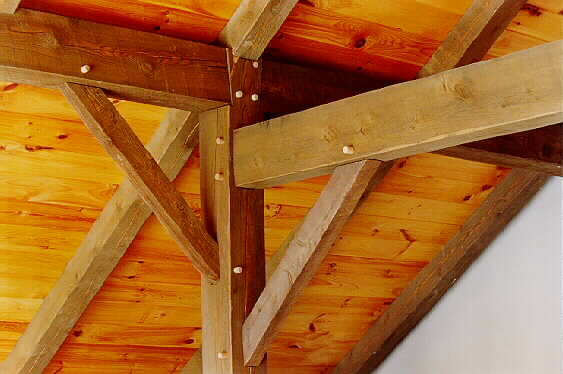
I found Vermont Timber Works online today. They have done some impressive work and have a very nice explanation of their methods at http://www.vermonttimberworks.com/joints.html

This picture is a great example of mortise and tenon work.
Here is their "tools of the trade" page showing that they do a lot of their work by hand. Funny that I do not see a CNC machine.